To get the Zoom link, register here:
https://us06web.zoom.us/meeting/register/ioEMOLfMSUqc7siunzlHJA
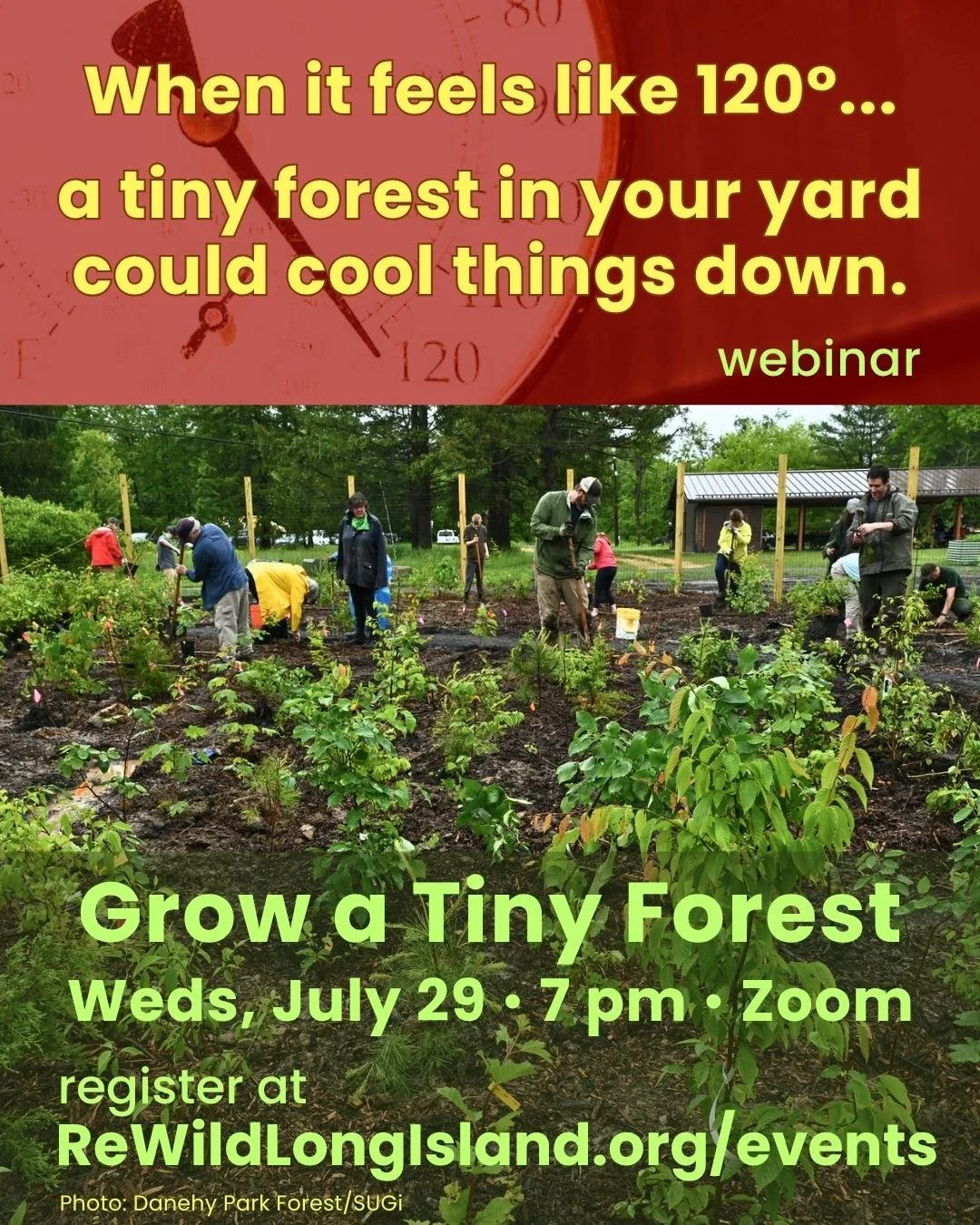
It feels like 120° out there.
A tiny forest in your yard could cool things down. Here's how.
Long Island just lived through a heat index of 110 degrees. Air conditioning bills are through the roof. And it's only going to get hotter.
Here's something most people don't know: a dense planting of native trees and shrubs, in a space as small as a few parking spots, can cool the air around it by up to 6 degrees, absorb stormwater before it floods the street, and become completely self-sustaining in just three years.
It's called a Miyawaki tiny forest. And it's one of the most practical things a neighbor, school, library, or civic group can do right now.
After three years of light maintenance, a Miyawaki tiny forest runs itself. Trees grow as much as 3 feet per year. Birds, bees, and butterflies move in. The dense canopy keeps cooling the air and soaking up rain long after you've moved on to other things.
Join environmental educator Mark Haubner for a free webinar on how it works, what it takes to plant one, and what it could mean for your corner of Long Island.
You'll learn about:
Deep soil preparation that helps rainwater soak in right where it falls, protecting Long Island's sole-source aquifer.
The four-layer approach – native oaks, hickories, understory shrubs, and groundcover – creates rich, resilient habitat for local wildlife.
How dense planting naturally eliminates weeding, mowing, and chemical fertilizers after year three.
Practical steps for organizing a planting day in your own neighborhood.
Wednesday, July 29, 7 - 8 pm
Free webinar via Zoom. Registration required.
To get the Zoom link, register here:
https://us06web.zoom.us/meeting/register/ioEMOLfMSUqc7siunzlHJA
Got questions? Email duong@ReWildLongIsland.org or Nancy@ReWildLongIsland.org
More events at ReWildLongIsland.org/events
ABOUT MARK HAUBNER
Mark Haubner is an environmental educator, facilitator, and community guide from the East End of Long Island, on the ancestral land of the Corchaug people. Through his work with local environmental nonprofits and government committees, he helps communities achieve visible, lasting environmental results, guiding neighbors and local governments in implementing nature-based solutions that regenerate ecosystems and strengthen communities.